


 59 minutes ago
8
59 minutes ago
8
ADVERTISE HERE
SIBU: The Rajang River has always been Sibu’s lifeline.
For generations, the river carried people, timber, goods and commerce through the heart of Sarawak.
Today, its banks are also home to an industry whose reach extends far beyond the river itself.
From shipyards scattered around Sibu, steel vessels emerge bound for Indonesia, Singapore, Australia, the Middle East and even West Africa.
World-class tugboats, landing craft, crew boats, barges and offshore support vessels built beside the Rajang are increasingly finding their way into international waters.
It is a remarkable transformation for a town whose shipbuilding roots were forged in river-based boatbuilding.
Malaysian Shipbuilding/Ship Repair Industry, in its 2025/2026 Report, recognised Sibu as Malaysia’s largest shipbuilding cluster, with more than 40 shipyards concentrated mainly around Sungai Bidut, Rantau Panjang and Tanjung Manis.
Sarawak has about 78 shipyards out of almost 100 across Malaysia.
Together, these yards have developed expertise in building a wide range of vessels, including tugboats, fast crew boats, landing craft, barges, ferries and fishing vessels.
But what distinguishes Sibu is increasingly not what it builds but where those vessels end up.
The Sarawak Association of Maritime Industries (SAMIN) reported in 2021 that Sibu’s shipyards were strongly export-oriented, with tugboats accounting for the largest share of vessels built at 88.2 per cent, followed by landing craft at 86.3 per cent, barges at 70.6 per cent, offshore vessels at 43.1 per cent and general cargo vessels at 41.2 per cent.
Between 2016 and 2020, foreign markets accounted for 76.9 per cent of the market for Sibu and Sarawak shipyards, followed by Sarawak’s own market at 17.1 per cent and the rest of Malaysia at six per cent.
At state level, the industry’s expansion is reflected in the numbers. Currently, 90 per cent of Sarawak’s shipyards are involved in the international shipbuilding market.
Deputy Premier and Minister for International Trade, Industry and Investment Datuk Amar Awang Tengah Ali Hasan, in his ministerial winding-up speech at the Sarawak Legislative Assembly on May 15, 2024, said that Sarawak’s shipbuilding and ship repair industry contributed RM562.19 million to the state’s external trade in 2023.
This was increased to RM873 million in global exports in 2025, — an increase of 55.34 per cent.
The vessels were exported to markets across Southeast Asia, including Brunei, Indonesia and Singapore; Oceania, including Australia, the Solomon Islands, Papua New Guinea, the Marshall Islands, Samoa, Fiji and New Zealand; as well as China, Taiwan, India, the Maldives, Sri Lanka, Bangladesh, the United Arab Emirates, Russia, Africa and North America.
Awang Tengah revealed that when he was at the Sarawak Mega Fair 2025 at Suntec Singapore Convention Centre in October 2025, the Shipbuilding Association secured almost RM2 billion worth of orders from foreign buyers in just one day.
The numbers point to something larger than the growth of individual shipyards.
They point to Sarawak’s emergence as one of Malaysia’s important maritime centres, which is a key contributor to the state and country’s economy.
Shipbuilding is an important heavy industries in Sarawak that is among top contributors to GDP.
The industry has deep roots in Sibu and has the potential to continue growing.
According to government figures, the biggest contributors to Sarawak’s economy are natural resources. Gas contributes about 49 per cent, petroleum about 26 per cent while the rest comes from sectors such as timber and palm oil.
As an example, in December 2025, Sibu shipyards deliver nine vessels worth nearly RM73 million to Singapore’s Winning Group for West African operations.
These vessels comprise tugboats and harbour tugs, was deployed for the group’s offshore logistics and transhipment operations at the Port of Guinea, West Africa, as part of its expanding overseas port operations.
This delivery reinforced the state’s reputation as a rising force in global shipbuilding.
For Dr Renco Yong King Hwa, president of Sarawak Association of Maritime Industries (SAMIN), the industry’s importance can also be measured by the people who depend on it.
“We estimate that between 10,000 and 12,000 people are employed in the maritime-related sector in Sarawak,” he said in an exclusive interview with the Sarawak Tribune.
“In Sibu alone, there are approximately 4,000 to 5,000 workers in the shipbuilding industry.”
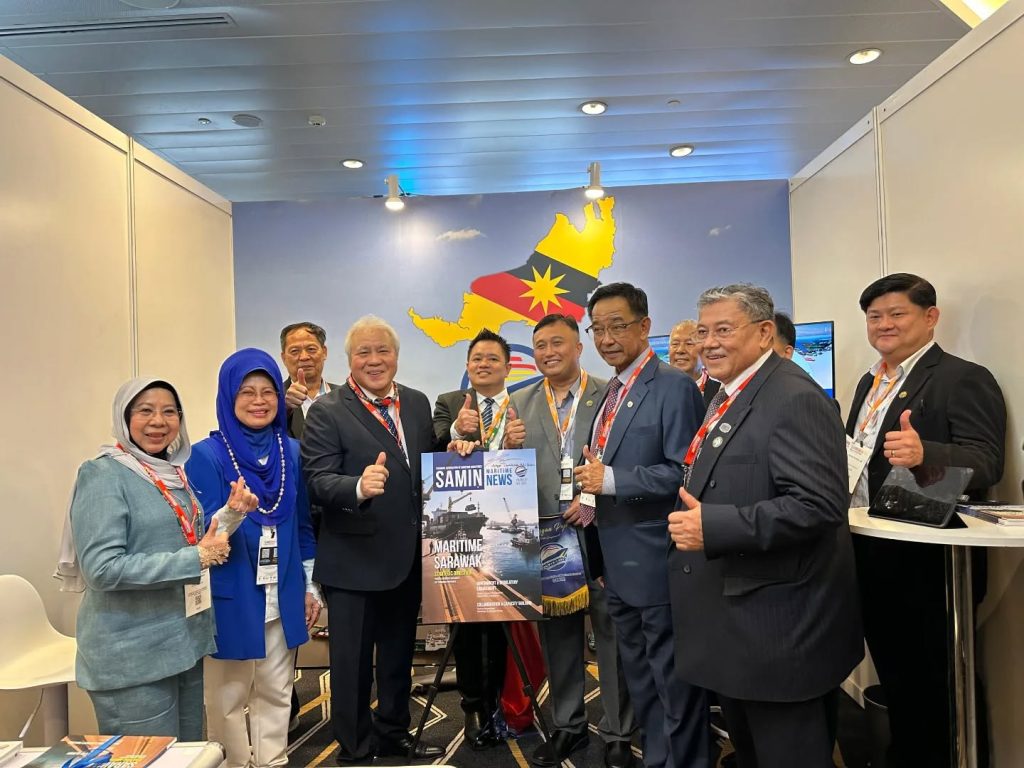 Awang Tengah (fourth from left) with SAMIN members and other ministers at at Suntec Singapore Convention Centre.
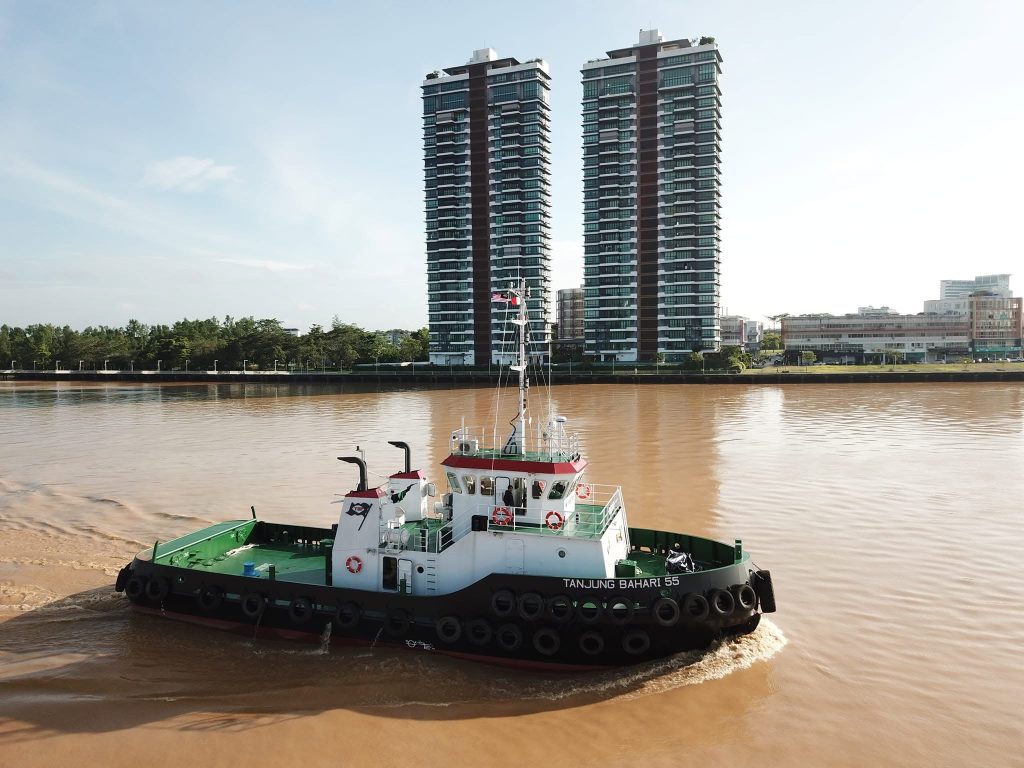 Test-drive a newly built tugboat of Rajang Maju Shipbuilding Sdn Bhd in Sibu.
That figure does not include port operators, shipowners, ship operators and seafarers, meaning the industry’s actual economic footprint is considerably wider.
Sixteen shipyards are located in the Rantau Panjang Shipbuilding Zone, while others are scattered around Salim, Sungai Merah, Kuala Igan and the area near the Igan Bridge.
Their international reach is perhaps best illustrated by a recent delivery involving nine vessels worth about RM73 million.
Built in Sibu and delivered to Singapore-based Winning International Group, the vessels were intended for the company’s operations in West Africa.
A ship built beside the Rajang could therefore end up working thousands of kilometres away.
Established shipbuilders such as Gimhwak Enterprise Sdn Bhd, Yong Choo Kui Shipyard and Shin Yang have similarly built hundreds of vessels for customers in Australia, Singapore, the Middle East, Europe and other parts of Asia.
Sibu’s shipbuilding industry has clearly outgrown its origins.
Yet it has done so without becoming a giant in the conventional sense.
China, South Korea and Japan dominate the global shipbuilding industry, accounting for about 92 per cent of world production, according to Yong.
Malaysia ranks around 14th to 16th globally, behind countries such as Indonesia, Singapore, the Philippines and Vietnam.
Sibu cannot compete with the biggest shipbuilding nations on sheer scale.
Its competitive advantage lies elsewhere.
“I would say our shipyards are very competitive, particularly in terms of delivery time, quality and integrity,” said Yong, a certified technological specialist.
For customers looking for smaller vessels, particularly those of around 120 metres and 10,000 tonnes, Sibu can offer a combination of price, proximity, flexibility and delivery time.
Sibu’s strategic location also works in its favour.
A vessel built in China and destined for Southeast Asia may have to travel considerably farther before reaching its market, involving higher delivery costs. The same applies to vessels destined for the Middle East or Africa.
Sibu’s relative proximity to these markets can reduce delivery distances and potentially lower costs.
“Transporting a ship from China to Malaysia can easily cost around RM600,000 to RM800,000. That includes transportation, manpower and other related costs. If you are delivering the ship to Australia, the distance is even greater and the delivery time is longer.
“When customers calculate the overall cost, they may find that there is not so much difference. They may then decide, ‘I might as well build it in Malaysia.’
“The same applies to Indonesia and other countries. For example, we have built ships for the Maldives government.
“We are now also building ships for the Papua New Guinea government. In some cases, government representatives, including ministers, come directly to us to discuss shipbuilding projects.
“Because of this, Sibu can still remain one of the important shipbuilding centres in Southeast Asia.”
The cost of building ships is another factor favouring Sibu.
“This trend is going to push business towards Sibu because China and Indonesia have started ordering from it while Australia and New Zealand are also potential markets.
“In Australia, for example, the cost can be about three times higher than here. If we build a ship for RM10 million, they may need around A$10 million to build a similar ship because their cost of living and labour costs are much higher.
“It is similar to the situation in Singapore. If you build a ship here for RM3 million, you may spend three times as much in Singapore or Australia. So, instead of building one ship there, you could potentially build three here.
“Previously, customers preferred to build ships in China because it was cheaper. If you go back 10 years, the exchange rate was around RM2.10 to the Chinese yuan. At one point, it was around RM1.20 to RM1.30. Now it is about RM1.50. The difference is no longer as significant.
“When the exchange rate was around RM1.70 to RM1.90 for a long period, the cost advantage of China was much greater. For example, if you could build three ships in Malaysia for the same cost as one in Australia, you might have been able to build six in China. That was why China was so competitive then.
“But now the difference is much smaller. If you can build three ships in Malaysia, perhaps you can only build four in China. The cost difference is not that significant anymore, especially when you consider the distance.”
Sibu has another competitive edge: its shipyards are inland and work with freshwater rather than seawater.
“We do not need to worry as much about corrosion caused by salty seawater. Batam, Singapore and Venezuela, for example, are all located by the sea. Sibu is different because we are inland and have freshwater.
“Even places such as Miri are located near the river mouth, where the water is salty. When you are dealing with saltwater, you need much more corrosion prevention. You have to clean and paint the vessels, but after a few weeks, they can start to corrode again.
“So, before building a new vessel or repairing one that has already corroded, you have to brush and repaint it.”
There is another competitive strength that is less tangible but important in international business: language.
Malaysia’s widespread use of English means contracts, technical documentation and business communications can generally be conducted without the language barriers that may arise in some other major shipbuilding countries.
“In Malaysia, our contracts are in English and our business communications are also in English, making it much easier for us to conduct business internationally.”
Strong support from the Sarawak government has also helped the state’s shipbuilding industry sustain and expand its operations.
“When we talk about Sibu and Sarawak, the Sarawak government has actually given our industry a lot of support. I would not necessarily call it benefits, but it has provided an easier environment for our industry to sustain itself compared with Peninsular Malaysia.
“In Peninsular Malaysia, there are many more regulations and rules governing the sector. For example, if you want to establish a new shipyard, you need approval from between 17 and 19 departments, which include the Ministry of Defence, the Navy, the Immigration Department and the Fisheries Department.
“Therefore, Sarawak does not have to deal with all those complications. When we establish a new shipyard, we only need to obtain approval from about six or seven government departments.”
The shipbuilding industry in Sibu could also prosper as it has a good ecosystem and a strong supply chain as compared with shipyards in other places, such as Sabah and even China.
Shipyards in Sibu have access to all the equipment and raw materials required to build vessel.
“Here, we have companies that specialise in marine hardware and equipment. We even have companies producing marine equipment such as winches, windlasses and cranes.
“All of these businesses help to bring down the overall cost of shipbuilding.
“I have friends from the Peninsular who have visited me, and I brought them around to see some of the shipyards and marine equipment suppliers.
“They told me, ‘This is like heaven to us,’ because you can basically get almost everything you need in one place.
“Unlike in the Peninsular, where they may have to travel to different places to source different equipment and materials, all that additional logistics increases the cost of building a vessel.
Here, we have a complete ecosystem, and most of the things are readily available,” naval architect Peter Tay.
Even when shipbuilders from Sabah get a new building project, they often come here to shop for the equipment and materials they need. They can buy everything, put it into containers and ship it over. So, in terms of logistics and supply, Sibu has a very good advantage.
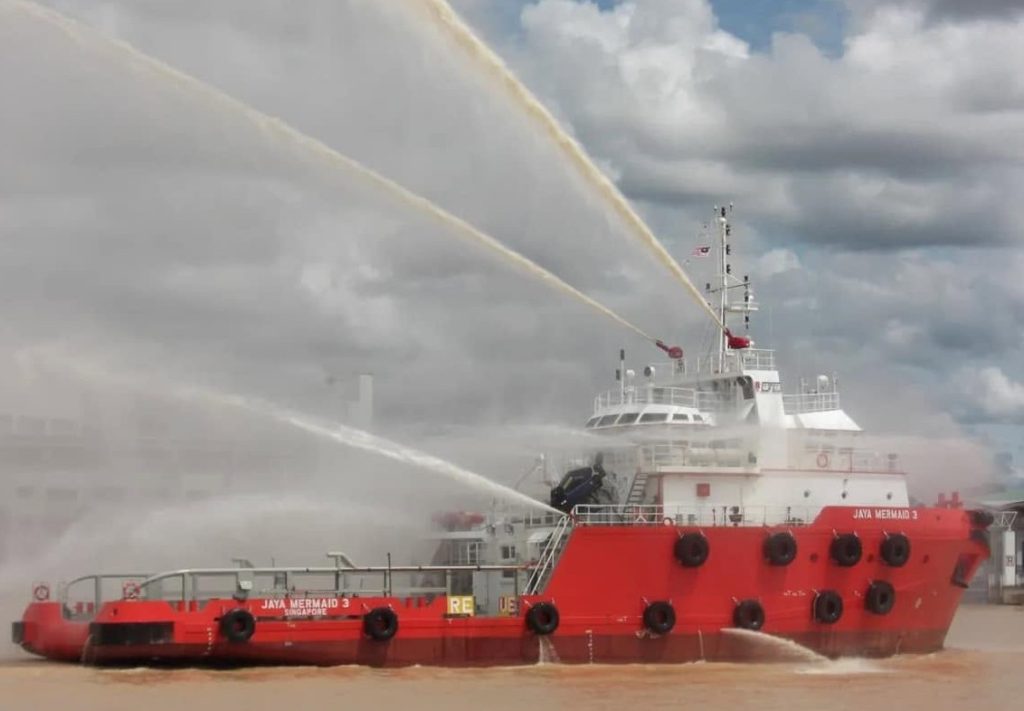 An off-shore supply vessel of Tuong Aik Shipyard.
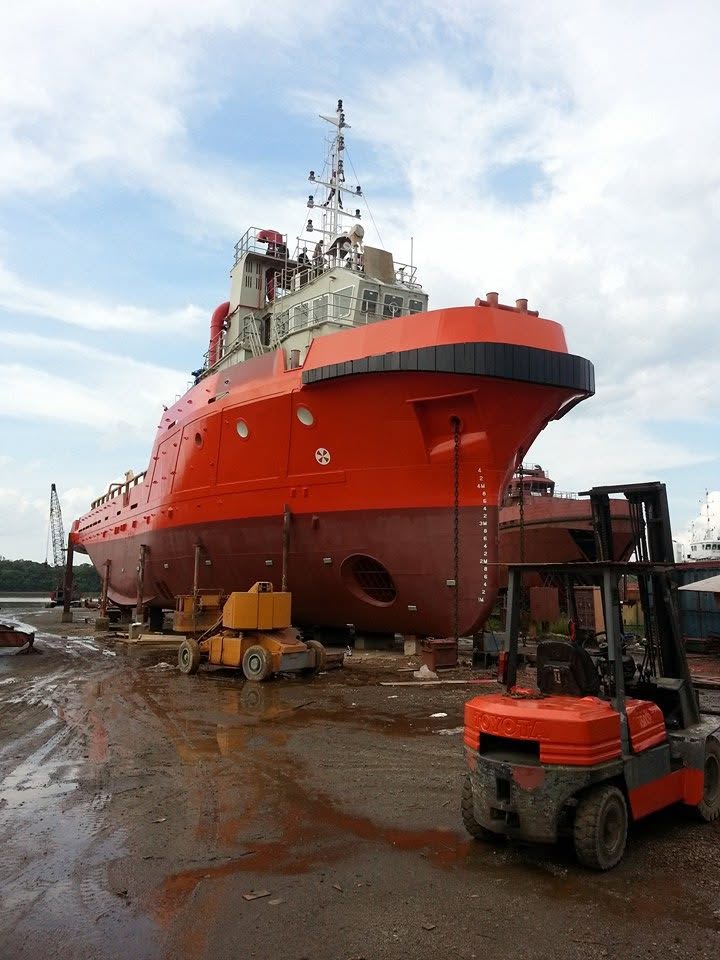 An utility vessel of Tang Tiew Hee and Sons Shipyard.
Those strengths have helped Sibu carve out a niche in the regional and international shipbuilding market.
It may never rival the massive shipyards of China, South Korea or Japan in terms of scale. But Sibu has shown that a shipbuilding centre does not have to be the biggest to be competitive.
Its strength lies in knowing its market, understanding its customers and making the most of what it has — skilled workers, competitive costs, a freshwater working environment, strategic access to regional markets and decades of shipbuilding experience passed down through generations.
Most importantly, the industry has shown that it can adapt.
From wooden boats built to serve communities along the Rajang, Sibu’s shipyards have evolved into builders of steel vessels that cross oceans and serve customers thousands of kilometres away.
The river that once carried Sibu’s boats downstream has become the starting point for vessels that carry the name of Sibu far beyond Sarawak.
But staying competitive is another matter.
In an industry where technology, costs, regulations, manpower and global competition are constantly changing, the strengths that have brought Sibu this far cannot be taken for granted.
For an industry built on the banks of the Rajang and now connected to markets across the world, the next challenge may be more difficult than reaching those markets in the first place — holding on to them.







 English (US) ·