


 6 months ago
117
6 months ago
117
ADVERTISE HERE
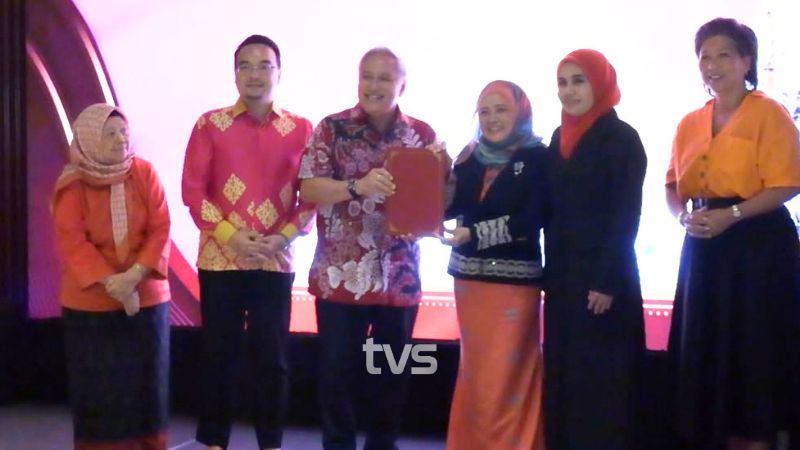
 Chew (right) witnessing the signing of a strategic joint venture agreement establishing Saint Gobain-Flinken between Weber (fourth right) and Chai (fifth left) at STATOS office in Singapore on April 13, 2026.
Advertisement

By DayakDaily Team
KUCHING, April 14: Global construction materials leader Saint-Gobain and Sarawak-based construction materials specialist Flinken Group are planning to develop a dedicated Southeast Asia logistics hub in Sarawak, as part of a newly formed joint venture aimed at accelerating the supply of light and sustainable building materials across the region.
The strategic partnership has been formalised through the creation of Saint-Gobain Flinken, with Saint-Gobain holding a 70 per cent majority stake and Flinken Group holding 30 per cent, according to a media release today.
Advertisement

The signing ceremony for the joint venture was held at the Sarawak Trade and Tourism Office Singapore (STATOS) on Monday (April 13), and witnessed by Saint-Gobain Malaysia and Singapore chief financial officer Tim Ooi and Flinken Group founder Phua Pui Ann. The event was graced by STATOS chief executive officer (CEO) Chew Chang Guan.
The joint venture will focus on meeting rising demand in Malaysia and Southeast Asia for advanced, low-carbon construction solutions, supported by phased investments in manufacturing upgrades and logistics infrastructure.
A key component of the collaboration is the planned development of a dedicated logistics hub in Sarawak, featuring enhanced warehousing and distribution facilities. The hub is expected to serve both domestic needs and function as a potential export gateway for sustainable construction materials across Southeast Asian markets.
Saint-Gobain Asia CEO Ludovic Weber said the partnership reflects the company’s strategy of combining global expertise with local capabilities to accelerate sustainable construction practices.
“This partnership reflects our strong belief in the importance of combining global expertise with local capabilities to accelerate sustainable construction… This is a key step forward in shaping the future of sustainable construction in the region,” he said.
Flinken Group founder Marcus Chai said the collaboration marks a significant milestone for the Sarawak-based company, which has grown from local roots into a manufacturer of high-quality mortar solutions.
“From our roots in Sarawak, Flinken Group has grown steadily into a leading local manufacturer… We are excited to continue growing the company together while supporting the development of Malaysia’s building materials industry,” he said.
The joint venture comes at a time when Malaysia’s construction sector continues to expand, driven by urbanisation, infrastructure development, and increasing demand for greener building solutions. Industry projections indicate the country’s green building materials market is expected to grow from USD385.4 billion in 2025 to USD677.2 billion by 2031, reflecting stronger adoption of sustainable construction practices.
Sarawak, in particular, is advancing its sustainability agenda under the Sarawak 2030 Sustainability Blueprint, with emphasis on green buildings, smart city development, and low-carbon urban planning.
Saint-Gobain Malaysia and Singapore CEO Lynette Siow said the partnership aligns with Malaysia’s broader transformation towards sustainability-driven construction.
“As Malaysia enters a transformative decade, technology, innovation and sustainability will increasingly define its built environment… This joint venture underscores our confidence in Malaysia’s long-term growth,” she said.
Beyond infrastructure development, the joint venture will focus on four key pillars: research, development and innovation; knowledge transfer and talent development; sustainable building and local industry empowerment; and community and policy engagement.
These initiatives include a dedicated RDI framework for tropical climate construction solutions, industry training programmes with engineering institutions, development of eco-friendly dry-mix materials using local resources such as kaolin, lime and palm waste, as well as collaboration on youth STEM outreach and green building policy discussions.
Chew said the partnership reflects Sarawak’s growing appeal as a destination for strategic investment in sustainable industries.
“As Sarawak continues to position itself as a forward-looking economy, foreign direct investment and strategic collaborations such as this play a vital role in advancing our ambitions in sustainable construction, green technologies, and human capital development,” he said. — DayakDaily


 English (US) ·