


 2 months ago
46
2 months ago
46
ADVERTISE HERE
SARIKEI, August 10: Tanjung Manis synonymous with the name 'production house' has become an identity of the district, even becoming one of the sources of income for local communities.
Interestingly, a new potential is now emerging that has begun to steal the attention of the agro-food sector when milk tomatoes from Kuala Rajang not only attract taste with their sweetness, but also have the opportunity to become high value agricultural products in the state.
It all started with the long-term efforts of a local businessman, Attar Salleh who was highly convinced that this plant could be among the high potential commodities in Sarawak.
For him, milkweed was not a continuously productive crop, spending almost five years researching and testing various cultivation methods before entering the commercial world.
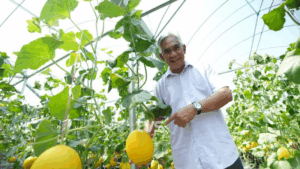 Attar has managed to harvest nearly 900 milk tomatoes for her fifth block of yellow houses recently. Photo by Faitullah Morni (TVS)
"For the first time (in 2017), we were engaged in science with an agricultural practitioner, Morshidi from Samarahan to guide crops. We started with a 3,200-square-foot rain shelter structure containing 415 polybags.
"We chose 'rock melon' because it's a bit foreign and never seen by anyone on the Sweet Cape", he told TVS.
According to Attar, the initial attempt paid off when 77 rock melons were harvested.
It was also given to the then Chief Minister of Sarawak, Datuk Patinggi Tan Sri Abang Johari Tun Openg while he visited Mukah.
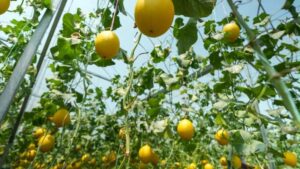 Milk tomatoes coming of age in the fifth greenhouse. Photo by Faitullah Morni (TVS)
Attar's success attracted Brother Johari's attention so much that he received an allocation of RM1 million to develop the dairy tomato plantation project.
"However, we had to switch to chili cultivation in 2019 because we found the market and demand was better than melons", he said.
Obviously, the risk of planting melons is also higher because each cycle of the crop needs to be restarted after harvesting, as opposed to ciliates that are capable of harvesting up to six rounds.
However, the COVID-19 pandemic forced Attar to halt the planting efforts when agricultural supplies were difficult to obtain.
HOPE for the Golden Fleece
The turning point came when he was introduced to a dairy farmer from Ulu Yam, Selangor who applied unique cultivation methods.
"This way, he doesn't use a water pump system (for irrigation systems), only gravity, so it reduces the operating costs.
"We don't have to worry about coconuts or the cost of replacing them, so there is a desire to start growing melons again in the form of research and development (R&D)", he said.
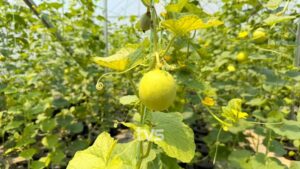 The unripe milk tomatoes in the third greenhouse. Photo by Amira Shawel (TVS)
According to him, with the support of the Kuala Rajang State Legislative Assembly (ADUN) Member, Datuk Len Talif Salleh, efforts to raise funds for the re-implementation of the project were finally realized.
With the injection of funds, construction of greenhouse structures will begin in December 2025, before seeds start to be sown in January this year.
A total of six 4,200-square-foot greenhouses have been developed, each housing about 1,100 lily milk potato trees.
However, he said, the journey of working on dairy coconuts in the Sweet Cape was not easy, especially at an early stage.
"The first block is only 391 seeds, the rest are not. Some fruits are too small, crumbling, and spoiled before ripening. The second block unfortunately didn't happen because the seeds were contaminated with salt water and could only last five weeks, then die", he said.
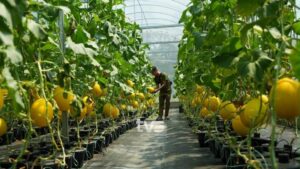 A precision farming system or precision farming makes it easier for farm workers to check the needs of each crop. Photo by Faitullah Morni (TVS)
Entering the third block, experience from previous failures served as a guide to improvement, thus seeing yields increase to 427 seeds.
"The fourth block improved, we got 650 seeds. Now it's the fifth block and we have 860 seeds now", he said.
Now, for each crop cycle, one greenhouse is capable of producing nearly 900 milk tomatoes to market, with a harvest rate of about 85 percent.
Within a year, he said, each greenhouse has the potential to undergo up to six plant cycles, thus enabling continuous production.
Getting Innovative by Planting Melons in Sweet Trees
What draws the authors' attention is the innovative approach and technology applied at every stage of cultivation.
Imitating methods introduced by entrepreneurs in Ulu Yam, Attar describes the cultivation system used combining two approaches namely fertigation and hydroponics.
He said the combination was also consistent with the uncertain weather of the Sweet Cape.
" (Technology) this fits the weather here which is rather extreme. Sometimes it's very hot, sometimes cold and wet so you have to change the process of processing the fertilizer, even the water level in the plant basin has to be changed according to the weather", he said.
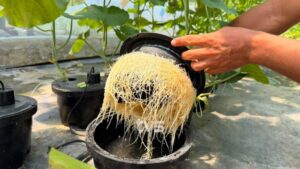 Virgation and hydroponic hybrid systems do not require any cocoons but are capable of growing tree roots. Photo by Amira Shawel (TVS)
In fact, the used pods were also specially commissioned from agricultural engineers to ensure that their design was consistent with the hybrid cultivation methods applied.
Attar added that he also did not expect the combination of these approaches to be able to produce such a rewarding result in just six months.
The combination of these approaches, he said, is not only suitable for the cultivation of dairy tomatoes, but also has the potential to be extended to other crops.
"This system is not limited to the cultivation of melons. It is also appropriate to use not only the cultivation of ciliates, for example, which are more profitable", he said.
In addition, the structures are also equipped with precision farming technology or precision farming which allows each tree to receive a controlled and on-demand supply of water and nutrients.
However, while the system is simple to operate, it requires high discipline and timing.
"If a task is to be done at 5:30 p.m., it must be done at that time too. It cannot be missed because it will disrupt the overall management of the plant", he said.
More impressively, the farming system used also allowed for the level of sweetness and texture of fruit to be targeted to maintain quality diversity.
This is especially when the level of humidity of choice varies according to demographics and buyer preferences.
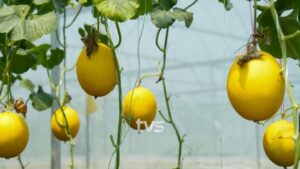 A greenhouse with 1,100 trees can produce more than 900 milk tomatoes at a yield of 85 percent. Photo by Faitullah Morni (TVS)
For example, the humidity level of Malaysians is on a Brix 15 scale, while demographics in East Asia prefer fruits at 12 °Bx.
"So far, in house number five, [the sweetness stage] is consistent at 15. So, it has been proven that the system is successful in controlling and targeting moisture levels", he said.
In the meantime, the system also helps entrepreneurs target the ideal weight to harvest dairy tomatoes.
According to him, the optimum weight for harvesting is 1.2 kilograms (kg).
"If it's too big, people tend to buy less, while if it's too small, the return is less than ideal: 1.2 kg to 1.5 kg", he said.
Getting the Fruit of Gold
Commenting on the profitability potential, Attar explained that this agro-food sector is able to give an attractive return to entrepreneurs, taking into account a harvest rate of around 85 percent.
For example, if milk turkeys were sold for RM10 per kilogram, entrepreneurs could potentially earn up to RM9,000 per turnover.
"If we do four rounds for one house in a year, it's RM45,000. Especially if in rural areas after declining all costs, it can still achieve almost RM30,000 net income", he said.
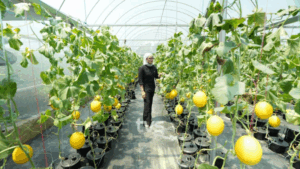 The journalist, Amirah Shawel is visiting a dairy farm in Kuala Rajang. Photo by Faitullah Morni (TVS)
In addition, she has also started marketing her dairy products to local markets, including some supermarkets in Kuching.
Seeing the potential to market these Kuala Rajang milk tomatoes internationally at a premium, Attar said that desire was part of his plan.
"Exports in terms of returns are higher and so is demand. Besides, we can also raise the Sarawak name to show that Sarawak can also produce its own agricultural products", he said.
He said, however, supply assurance for the local market is a priority at this time.
According to him, the desire to penetrate international markets will be realized if local production is strong enough and able to meet demand consistently.
Regarding capital requirements, Attar said about RM2,500 was enough to start small-scale dairy cultivation.
"If one poly bag is around RM20 to RM25, for 100 bags it means about RM2,000. This is the basics", he said.
In addition, the capital requirement also included the cost of setting up a planting and irrigation system, thereby making such planting methods more affordable and viable for small-scale entrepreneurs.
Feeding Hope as a Meal
However, for Attar, the achievements achieved are insignificant if the knowledge and experience gained cannot be shared with society.
He said that the success should be developed among local communities to strengthen food production in the state and open up more economic opportunities.
With a simple system and low capital requirements, Attar wanted to encourage more communities, especially young people to venture into commercial dairy tomato cultivation.
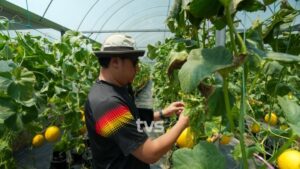 News editor, Shafik Ahmad visited a dairy farm in Kuala Rajang. Photo by Faitullah Morni (TVS)
"One of the great aspects about this project is to provide employment opportunities for local children who are in dire need of employment opportunities at their own place. There are young people who have no choice but to emigrate because they care for a sick parent.
"With projects like this, it provides opportunities for young people especially to earn income and the importance of acquiring new knowledge", he said.
He further said that the efforts were in line with the Sarawak government's desire to streamline agricultural activities and thereby achieve a level of food security.
In an effort to meet the challenges of the Sarawak Premier, he is working with the Sarawak Department of Agriculture to offer milk tomato cultivation courses to young people in the area.
According to him, the initiative is also supported by ADUN Kuala Rajang as an effort to encourage more participation from local communities reaching the sector.
"We're targeting 10 to 20 participants, not too many to focus more and have a higher chance of success.
Additionally, each participant will also be provided with a beginner kit so that they can grow on their own as a starter.
Meanwhile, Datuk Len Talif Salleh said the farming system using a modern approach could attract more young people to venture into the agro-food sector.
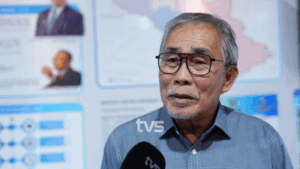 Len Talif Salleh's grandfather was found on TVS. Photo by Faitullah Morni (TVS)
He believes that the use of technology makes agricultural activities more systematic, manageable and competitive.
However, the Sarawak Department of Agriculture needs to establish a long-term plan in order to ensure that the initiatives can be implemented continuously and expanded to a broader level.
"If they're good at operating the system, are allocations being passed on to them so that they can get involved in the industry", he said.
According to him, such planning should also use an integrated approach involving multiple parties to ensure that every effort undertaken can move in a coordinated and successful manner.
He also saw the potential to make melon growing areas a new attraction for tourists through agro-tourism.
"If we go abroad, we'll go to the strawberry farm and grow it, then we weigh and pay. This is the kind of system we want to implement but it needs to be bigger and more consistent every year", he said.






 English (US) ·