


 1 week ago
17
1 week ago
17
ADVERTISE HERE
KUCHING: A longhouse headman who recounted fleeing his home as a six-year-old during the 1963 Indonesian Confrontation has appealed for research into the soldiers and villagers who engaged in the border conflict.
Ungau Alam, 70, a tuai rumah (longhouse headman), shared his childhood memories at a talk titled “Remembering Rantau Panjai”, organised by the Friends of Sarawak Museum at the Borneo Cultures Museum, Sunday.
The talk revisited the border conflict at Rantau Panjai, now known as Rantau Jawa, around Ayat River in Bangkit, Song.
Subtitled “A Childhood Witness to the 1963 Border Conflict”, the presentation covered the Confrontation along the Katibas and Bangkit river networks in the Third Division.
He said it was not a history lecture but a personal account of what he experienced during what he called a year of turbulence, uncertainty, anxiety and curiosity.
“What I remember as a six-year-old is not even a grain of sand compared to the vast shore,” he said.
Longhouse life disrupted
Ungau said life in the longhouse before the Confrontation revolved around weaving and children’s play, with no digital gadgets to connect people.
Everything changed when a man from his longhouse, Ado, was detained by Indonesian soldiers at the border while travelling an old trail towards Ulu Ayat. Ado and two companions eventually freed themselves.
During Ado’s absence, he said, weaving at the longhouse stopped because everyone was worried.
“I was more curious instead of fearful,” he said, recalling his feelings at the time.
News of the incursion spread quickly as longhouse members volunteered to alert neighbouring communities, he said. His family later fled by longboat to another longhouse downriver, where they were received by its headman.
He recalled seeing British soldiers for the first time during the escape, aboard a metal assault boat carrying two British soldiers and four Gurkhas. His family’s wooden longboat passed it in the shallow rapids.
“I had never seen a soldier before. I only knew the word warrior, because my great-grandfather, Balang Balai Nyabung was one,” he said.
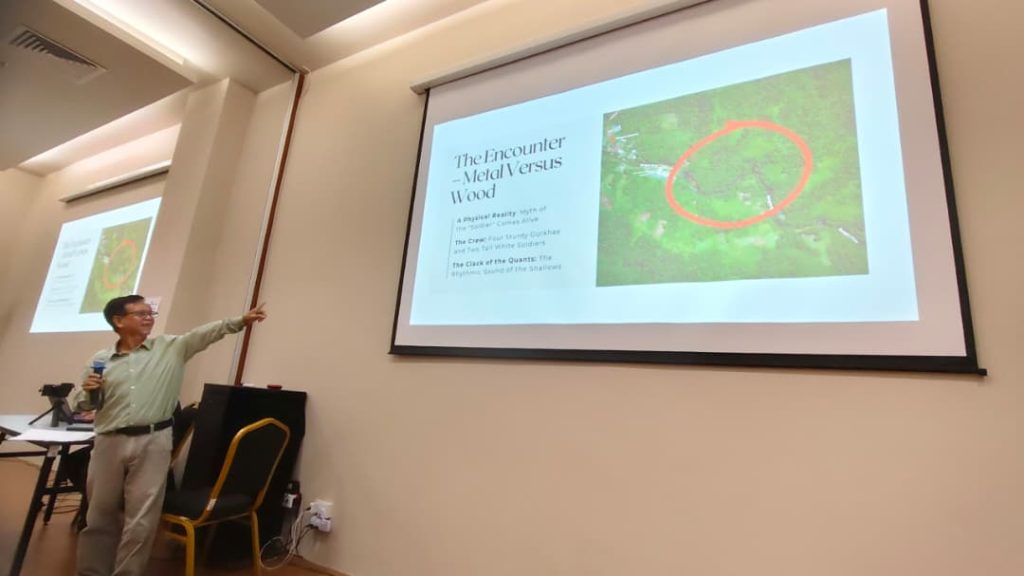 Ungau gives his talk on his memories of Rantau Panjai
Fallen officer
Ungau said he later learnt that a British officer was killed in an engagement with Indonesian soldiers near the river. The officer reportedly ventured far from his platoon and called on about 60 Indonesian soldiers, who were having lunch, to surrender.
He said he had spent decades trying to establish the officer’s identity. One possibility, he said, was Second Lieutenant Graham Rolls of 42 Commando Royal Marines, while another account pointed to Lieutenant Hugh Wallace of the 2nd Battalion, 6th Gurkha Rifles.
“I cannot validate which one is true,” he said.
He added that a local man, Ekeh, also known as Sendok, was wounded in the thigh during the clash but survived. Another villager, Ancha, helped recover the officer’s body the following day.
Ungau said the site, once a helicopter landing field, later became the school where he began Primary One in 1964, known as SK Tan Sri Datuk Temenggong Jugah today. Bullet marks, he said, can still be seen there.
He also recalled that British soldiers stayed at his longhouse for several days in 1964, with medical personnel treating the sick and handing out medicine and sweets to children.
Tribute to parents
Ungau also paid tribute to his late father, Alam Surai, a Baram veteran who fought the Japanese in World War II, and his mother, Tinyai Ugap, whom he described as the family’s emotional anchor.
He said his father, an introvert, rarely spoke of his past, and he learnt of his wartime exploits only through others.
“My father left me with a lot of silence, a lot of space,” he said.
Call for research
During the question-and-answer session, Ungau said stories of his father were best verified through elders in nearby longhouses, and invited researchers and students to visit his longhouse.
A researcher in the audience added that stories of the Confrontation were also preserved through Iban oral traditions, such as those of the lemambang (bards), across several longhouses along the river.
Ungau urged younger people to document the accounts of elders before they are lost.
“The field is so vast for researchers, but the workers are still few,” he said.




 English (US) ·